For centuries, water shaped Athens’ landscape and culture. The Kifissos and Ilissos rivers once flowed openly through the city, while smaller streams such as Eridanos crossed what is now the historic center. Effective water management was essential, both to regulate the local environment and to ensure reliable public access to freshwater resources. Water access was supported by an extensive network of springs, public fountains, and underground infrastructure such as aqueducts, cisterns, wells, and drains (Stroszeck, 2021).
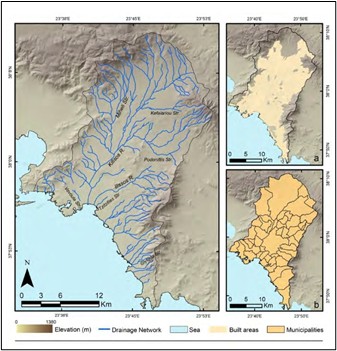
Figure 1: Map of Athens basin showing the river network, the built areas (a) and the municipality administrative limits (b) (Diakakis, et al. 2016)
Today, much of Athens’ hydrological network lies hidden beneath the city (Figure 1). Yet, it continues to influence flooding patterns, water availability, and the overall resilience of the urban environment. Both Kifissos and Ilissos continue to flow underground as small streams during drying periods, but can turn into strong torrents when heavy rain falls, often resulting in flooding. Only small sections of Eridanos become visible in the historic center of Athens.
How Athens became a climate hotspot
Athens rapid urban expansion demanded extensive built infrastructure that dramatically altered its relationship with water. The city grew into a largely grey landscape incorporating asphalt and concrete (Figure 2). Phasing out vegetation and soil spaces, Athens deprived its capacity for natural cooling and compromised the landscape’s ability to act as a “sponge” that absorbs rainwater. Lacking vegetation and permeable ground, heat stress in the city is also amplified. When summer heat waves strike Athens, the heat island effect intensifies, causing temperatures to rise up to 3.5 ℃ above average (Founda & Santamouris, 2017). Satellite data (Figure 3) show that the city experiences surface temperatures up to 10–12°C higher in dense, paved areas compared to nearby green spaces (Sangam, 2025).
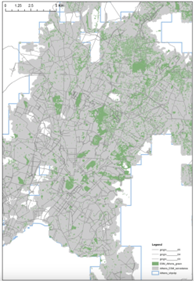
Figure 2: Athens -Green ESM 2016 Urban Green Areas and served areas (Pafi et al., 2016)
Parks, micro-forests, and green corridors act as ‘hubs’ and ‘links’ that help clean the air, improve the local microclimate, and support biodiversity in the city. However, green spaces in Athens cover only 0.4 km², about 2.8–3% of the municipality’s area. This means that each resident has access to just 2–2.5 m² of green space on average, far below the 9 m² per person recommended by the WHO (Papageorgiou & Gemenetzi, 2018). During peak summer days, this uneven distribution favors high temperatures, often exceeding 40°C, posing serious threats to public health.
Green areas with substantial vegetation remain significantly cooler. Parks and vegetated areas can reduce surface temperatures by 4–6°C on average, providing noticeable cooling even during heatwaves (Sangam, 2025). Rising temperatures, reduced rainfall, and prolonged droughts have disrupted vegetation and local biodiversity, leaving many green spaces weakened or abandoned. Athens’ reliance on traditional greening and underground drainage networks has reduced its capacity to tackle the effects of climate change and its severe impacts.
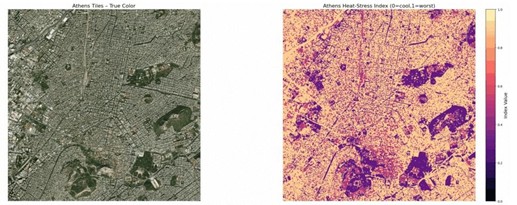
Figure 3: Raw satellite image of Athens on the Left, with a Heat Stress Index Analysis on the right. (0=cool, 1==worst) (Sangam, 2025)
Transforming conventional parks into cooling havens
The Cooling Havens project goes beyond simply planting trees or rebuilding park gardens. It proposes “a new kind of urbanism that thinks and acts beyond the traditional nature/culture divide” (Council of Europe, 2021). Cooling Havens tackles the complete loss of surface water flows in Athens, through nature-based interventions working together to reduce heat stress, enhance urban comfort, and improve residents’ quality of life. Six Cooling Points have been selected to demonstrate how nature-based solutions (NBS) can support resilient landscape architecture practices in Athens and promote long-term sustainability.
What are Nature-Based Solutions?
Nature-Based Solutions (NBS) are approaches inspired by nature that address urban challenges while delivering environmental, social, and economic benefits. They are increasingly recognized as among the most effective strategies to address climate change, both for adaptation and mitigation, and are considered to strengthen urban resilience through locally adapted, resource-efficient interventions (European Commission, 2021).
Technically, NBS use wetlands, green roofs, urban forests, or rain gardens to restore water, reduce heat, and support biodiversity simultaneously. Compared to conventional green infrastructure, they can withstand, adapt to, and recover from shocks like climate disasters, while ensuring long-term sustainability. They support not only water drainage, but also retention, infiltration, reuse, and evapotranspiration, that is, the total amount of water transferred to the atmosphere from the soil surface (evaporation) and through plants (transpiration), restoring basic processes of the natural water cycle.
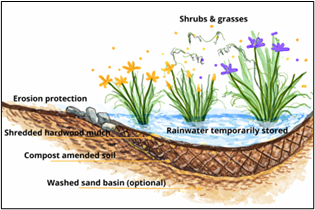
Figure 4. Rain garden example, adaptation made by the author.
Imagine rain gardens (Figure 4) that collect rainwater and filter it through layers of soil and plants; bioswales that guide excess water through shallow, planted channels, where it can seep into the ground rather than divert it into drainage pipes; permeable pavements that enable rainwater to reach the soil and recharge it, and landscape design aquatic planting beds that can temporarily store stormwater during heavy rainfall, easing pressure on drainage systems and preventing flooding.
Why NBS matter for cities like Athens
Particularly in highly constrained environments like Athens, NBS offer the potential to deliver multiple ecosystem services simultaneously. By mimicking natural processes, they can protect and regenerate abandoned green spaces, enhance biodiversity, improve air and water quality, and create more livable urban environments. Unlike traditional infrastructures, they are cost-effective, with low-maintenance needs (European Commission, 2021). They depend on regular monitoring and preventive maintenance. Routine inspections are important to allow early detection of issues such as plant stress, sediment accumulation, erosion, or blockages.
The role of communities in nature-based strategies
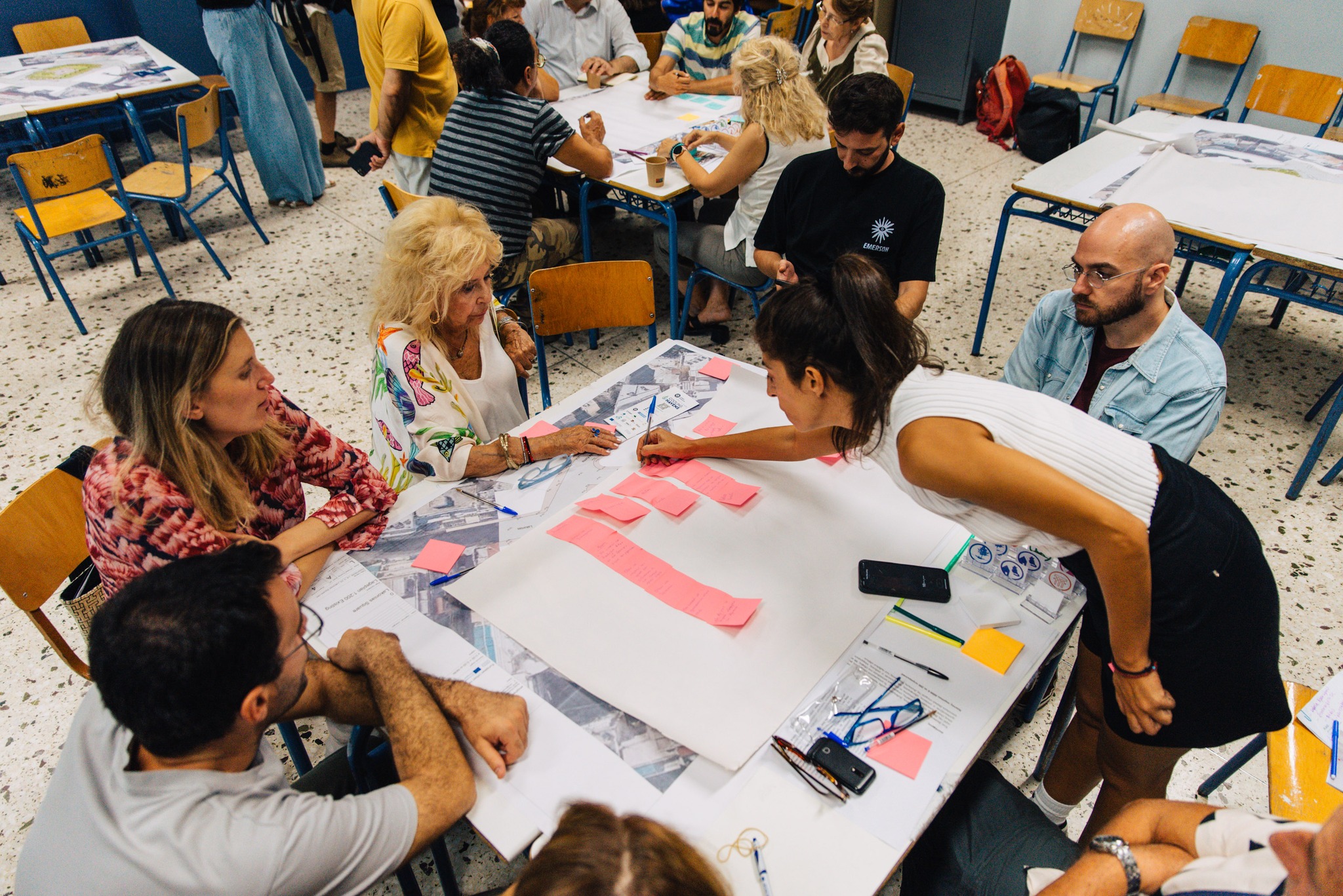
However, NBS success depends strongly on the local context, including environmental conditions, urban form, community needs, and stewardship. Community engagement is essential, not only for the co-design process and the impact evaluation of Nature-Based Solutions (NBS), but also to foster awareness, community stewardship, and a sense of shared responsibility through collaborative and co-productive approaches. The knowledge and experience of local stakeholders are necessary to help identify relevant outcomes, understand community needs, and support data collection.
Addressing these challenges early helps prevent system failures and avoids the need for more complex and costly interventions in the future. Achieving this, however, requires interdisciplinary collaboration, long-term planning, and a shift away from conventional urban planning approaches.
Towards a cooler, more resilient Athens
Athens stands at a critical turning point. As climate pressures intensify, conventional urban infrastructure and engineering solutions fail to reduce the risk of future disasters. Addressing heat, water scarcity, and flooding requires more than isolated interventions. It calls for integration of nature-based solutions into land-use planning for sustainable development and, overall, a systemic shift in how cities are designed and experienced.
By reconnecting urban environments with natural processes, nature-based solutions offer a pathway forward to transform Athens into a more resilient, livable, and climate-adaptive city.
Through its pilot sites, the Cooling Havens project demonstrates how this transition can take shape in practice, combining innovation, community engagement, and ecological design. These interventions are not only about cooling spaces, but also about redefining the relationship between people, nature, and the urban landscape.
In a city shaped by water for millennia, the future of Athens may once again depend on learning how to live with it.
Authors:
Maria Troullou, Co-founder, COO, MA in Cultural Studies & New Technologies
María de Lourdes Angeles Topete, Landscape Architect, MSc in Environmental Sciences & Policy
Polymnia Dagtzidou, Co-founder, CEO
References
Council of Europe (2021). Report “Urbanisation, town planning and landscape” and draft recommendation. 11th CE Conference on the European Landscape Convention, Strasbourg, 26-27 May 2021. CEP-CDCPP (2021) 6E. Available at: https://rm.coe.int/11th-council-of-europe-conference-on-the-european-landscape-convention/1680a249d8
Diakakis, M., et al. (2016) ‘Flood fatalities in Athens, Greece: 1880- 2010.’, Bulletin of the Geological Society of Greece, 47, p. 1407. Available at: https://doi.org/10.12681/bgsg.10962.
Directorate-General for Research and Innovation (European Commission) (2021) Evaluating the impact of nature-based solutions: a handbook for practitioners. Publications Office of the European Union. Available at: https://data.europa.eu/doi/10.2777/244577
Founda, D. and Santamouris, M. (2017) ‘Synergies between Urban Heat Island and Heat Waves in Athens (Greece), during an extremely hot summer (2012)’, Scientific Reports, 7(1), p. 10973. Available at: https://doi.org/10.1038/s41598-017-11407-6.
Pafi, M. et al.(2016) Measuring the Accessibility of Urban Green Areas: A comparison of the Green ESM with other datasets in four European cities. Available at: https://doi.org/10.2788/279663.
Papageorgiou, M. and Gemenetzi, G. (2018) ‘Setting the grounds for the green infrastructure in the metropolitan areas of Athens and Thessaloniki: the role of green space’, European Journal of Environmental Sciences, 8(1), pp. 83–92. Available at: https://doi.org/10.14712/23361964.2018.12.
Sangam, A.C., et al.(2025) ‘From Above the Acropolis: Satellite Analysis of Vegetation and Urban Heat in Athens’, IAAC BLOG, 25 April. Available at: https://blog.iaac.net/from-above-the-acropolis-satellite-analysis-of-vegetation-and-urban-heat-in-athens/ (Accessed: 14 March 2026).
Stroszeck, J. (2021) ‘Water and Water Management’, in D.K. Rogers and J. Neils (eds) The Cambridge Companion to Ancient Athens. Cambridge: Cambridge University Press (Cambridge Companions to the Ancient World), pp. 110–123. Available at: https://doi.org/10.1017/9781108614054.009.